Wednesday, 19 October 2016

Europe's Mars Landing on Wednesday May Be Visible to NASA Rover


Call it the Schiaparelli sky show — and if you happen to be NASA's Opportunity Mars rover, it's coming to a sky near you.

On Wednesday morning (Oct. 19), the European Space Agency's (ESA) ExoMars 2016 Schiaparelli Entry, Descent and Landing Demonstrator Module (EDM) is set to plunge through the Martian atmosphere and land on the planet's surface, all within six minutes. 

Its descent involves use of a heat shield, parachute, thrusters and a crushable structure for the landing. You can watch a live webcast of the ExoMars landing here, courtesy of ESA, beginning at 9 a.m. EDT (1300 GMT). 

Robotic eyewitness


The information gleaned by Schiaparelli during this short period will test and demonstrate technologies required to deliver a lander or rover safely onto the surface of the Red Planet.

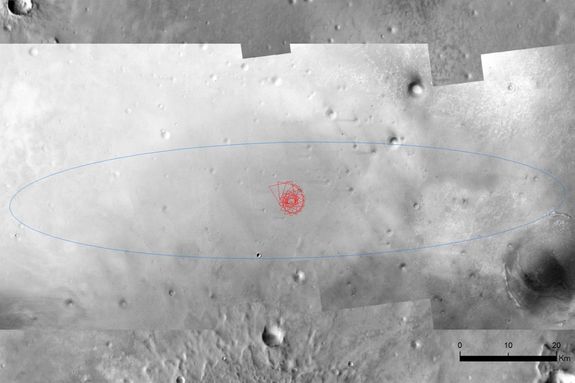
Once it was released by its mothership – ESA's Trace Gas Orbiter – on Oct. 16, Schiaparelli was aimed to plop down in a relatively flat area in Meridiani Planum, close to the equator in the southern hemisphere.

This region has been imaged extensively from orbit, including by ESA's Mars Express and NASA's Mars Reconnaissance Orbiter.


Opportunity rover's current location at Spirit Mound. Will it catch the Schiaparelli sky show?
Credit: James Rice/MER/JPL
In position as a potential robotic eyewitness to the craft's landing is NASA's Opportunity rover.

West toward the east


The Schiaparelli EDM will enter the Martian atmosphere and be moving from west to east in the sky above its landing site in Meridiani Planum.

That's the spot where Opportunity landed in early 2004. The rover is currently exploring Endeavour Crater in its 10th extended mission, explains astrogeologist Jim Rice, Mars Exploration Rover geology team leader and senior scientist at the Planetary Science Institute in Tucson, Arizona.


Remote chance


"We will attempt to image Schiaparelli as it arrives in our neck of the woods on Oct. 19," Rice told Inside Outer Space. "But if the entry and descent of the Schiaparelli EDM is nominal, the Opportunity rover will not see anything because its path will be blocked by the topography of the western rim of Endeavour crater," he said.

"However, there is a remote chance we could see it above the crater rim if the descent trajectory is long toward the east," Rice added. "Bottom line is that we will be giving it our best effort and, hopefully, we get lucky."


Approaching surface shots


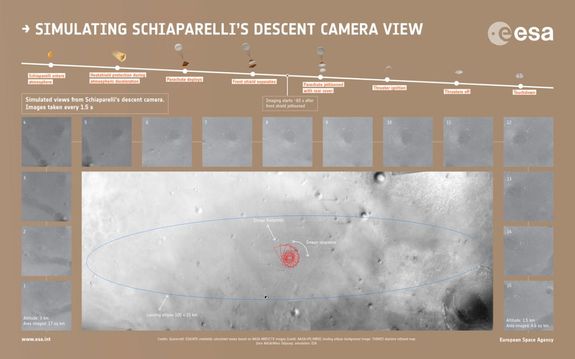
Meanwhile, as the ExoMars Schiaparelli module descends onto Mars, it will capture 15 images of the approaching surface, according to ESA's website. Scientists have simulated the view seen from the module's descent camera.

Those 15 black-and-white images snapped by a small camera named DECA — the DEscent CAmera — during Schiaparelli's descent can be used to reconstruct the module's trajectory and its motion, as well give context information for the final touchdown site.
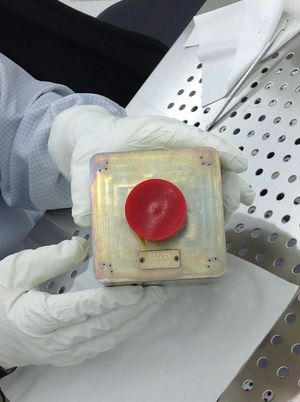
Pre-checkout with protective lens cap on, the DEscent CAmera (DECA) on Schiaparelli, the ExoMars 2016 entry, descent and landing demonstrator module.
Credit: ESA
DECA will start taking images after the front-shield of Schiaparelli has been jettisoned during the journey through the Martian atmosphere to the planet's surface. It will take the 15 images at 1.5 second intervals.

Local memory


The images will be stored in the vehicle's local memory. To avoid electrostatic discharges affecting the instrument, there will be a delay of several minutes after Schiaparelli has landed on the surface of Mars, before the data are read out by Schiaparelli's computer and subsequently downlinked to Earth.

DECA was designed and built by Optique et Instruments de Précision (OIP) in Belgium for ESA.

The ExoMars effort is a cooperative project between ESA and Russia's Roscosmos.

ExoMars 2016 comprises two missions: the Trace Gas Orbiter and the Schiaparelli entry, descent and landing demonstrator module, which were launched on March 14, 2016.

The follow-on ExoMars rover and surface platform is scheduled for launch in 2020.


Monday, 17 October 2016

NASA's Juno mission isn't exactly going according to plan

But that’s not necessarily a bad thing

        NASA
 
                           NASA’s Juno mission team is delaying putting their spacecraft into a shorter orbit around Jupiter — a key maneuver that was supposed to happen on October 19th. But for some reason Juno’s main engine is acting up, so NASA is now looking to pull off the operation on December 11th. The team hopes that will give them enough time to figure out why Juno’s engine isn’t working as expected. Juno has been in orbit around Jupiter since July 4th, and its path around the planet is a strange one. The spacecraft is on what is known as a highly elliptical orbit, meaning it spends most of its time far out in space and then spends a few short hours up close to Jupiter’s surface. This orbit is meant to keep the spacecraft away from most of the intense radiation that surrounds the gas giant. Right now, Juno’s orbit takes 53 days to complete, but that time period will eventually get shorter. After completing two of its longer orbits, Juno was supposed to ignite its main engine again and put itself into a 14-day orbit around Jupiter. However, NASA is a little nervous about doing this right now since parts of the main engine are not working as expected. Specifically, a pair of helium check valves, which help the main engine fire, didn’t work like NASA wanted them to during a command sequence on Thursday. "The valves should have opened in a few seconds, but it took several minutes," Rick Nybakken, Juno’s project manager, said in a statement. "We need to better understand this issue before moving forward with a burn of the main engine."
  
Juno's 14-day orbital paths. (NASA)
The best time for Juno to reduce its orbit is when it swings by the planet for a few hours in what is known as a perijove pass. That next pass is happening on Wednesday, but now NASA is going to wait for the following pass so that the mission team has more time to figure out what’s going on with the helium valves. That means Juno has at least one more 53-day orbit to complete before it can get into its shorter orbit. The delay isn’t all bad news though. Originally, the plan was to turn off all of Juno’s instruments on the 19th, so that nothing interfered with the engine burn. But since there’s no burn scheduled, the mission team is going to leave the instruments on while Juno passes close to Jupiter. Plus, the length of Juno’s orbit doesn’t affect the quality of the science the spacecraft can do. "The mission is very flexible that way," Scott Bolton, Juno’s principal investigator from the Southwest Research Institute in San Antonio, said in a statement. "The data we collected during our first flyby on August 27th was a revelation, and I fully anticipate a similar result from Juno's October 19th flyby." But the shorter Juno’s orbit, the more perijove passes it can make and the more science it can do during its mission at Jupiter. Hopefully, 53 days is enough time for NASA to figure out what’s up with Juno’s engine and get it working again.

Whatever maybe the challenges, human beings are likely to journey to Mars in the 2030s. The Red Planet’s average distance from the earth is 225 million kilometres and India sent forth its own spacecraft Mangalyaan which is presently orbiting the Martian atmosphere and sending back information regarding Mars surface features, morphology, mineralogy and of course the Martian atmosphere which does not have an ozone layer to protect human beings from ultraviolet radiation.But Ritu Karidhal, one of the speakers at 'Josh Talk' and deputy director of ISRO’s Mangalyaan programme believes this interplanetary mission will open the door for further significant space explorations including sending human beings to Mars. Karidhal said, "I believe Nasa is working on sending astronauts to [R1] Mars and they have made progress in this field. I believe they will be able to reach there in the 2030s.

"Of course they will have to prepare a suitable capsule to ensure pressure control and proper amounts of oxygen. But I am confident that under a controlled environment, human beings will be able to step out of the spacecraft and walk on the Martian surface soon," she added.

An image of Mars. Reuters

Advanced entry, descent and landing techniques that reduce the G-forces on landers will also need to be developed to ensure astronaut and spacecraft safety. India is presently not planning to send a man to Mars but rather, is in the process of preparing to send a manned flight to the moon. "Several challenges will have to be overcome before a manned flight can reach Mars from India but we are the fourth country to send a spacecraft in an interplanetary mission,’ said Ritu who has been involved with this process every step of the way. I was involved with the process from 2012 and this implied developing and mastering several technologies. We had to demonstrate that we could break free of earth’s gravity and then endure interplanetary space before entering Mars atmosphere," Karidhal explained.Once the Indian government took the decision to go to Mars, Isro had no time to lose as the nearest launch window was only a few months away and it could not afford to lose the chance, given the next launch would present itself after over 780 days, in 2016. India’s Mars Mission is the cheapest in the world and has cost only Rs 450 crores in comparison to the billions of dollars being spent by NASA. It was also completed in a record ten months time. It has meant travelling a journey of 660 million kilometres in 300 days with the spacecraft armed with five payloads including a methane sensor and a tri-colour Mars Colour Camera with the spacecraft costing $70 million in comparison to a Nasa mission cost of $671 million.

Karidhal said, "We had eighteen months in which to conceptualise and realise the project. We had to be precise in drawing up the perfect trajectory for the spacecraft and to ensure it cruised in the correct direction. In the past, both Russia and NASA have had failed attempts while sending their spacecraft to Mars." From 51 missions to Mars, only 21 have been successful so far.

Everything, from mission planning, manufacturing the spacecraft and the launch vehicle and readying the support systems took place at a rapid pace."We spent a great deal of time testing the space craft. We had to build extremely sensitive antenna for deep space communications and navigation-guidance-control capabilities," said this eminent woman scientist. "My main role was to ensure that the systems were capable of taking the right decisions. We had to conceptualise and ensure the execution of the craft’s onward autonomy system which can be explained as the brain of the satellite. This is a coded software system that functions on its own and can decide to detach anything that must be infracted," she said .

Ritu_K_Wiki_380 

To explain in easier language, if there is a malfunction, the system needs to be designed well enough to correct and recover on its own when it is moving in outer space.,’ said Karidhal. Ritu was deputy director operations and she along with her team of scientists, had to ensure all the configurations were right because a single anomaly could have jeopardised the entire operation.

Mangalyaan continues to revolve around the Mars. "The missions life was six months but it has already crossed two years," she said.

Mangalyaan, she pointed out, has already sent back huge amounts of data which is being presently analysed by physicists and scientists. On the key question of whether there is water in Mars, Ritu believed there could be water but more evidence was required on this subject.

All this information is going to be of prime significance if humans decide to set up colonies in the Mars. Private players have also stepped in and want to beat NASA in this race. Already a Dutch NGO Mars One is planning to send two men and two women to the red planet with their spacecraft expected to take off in 2024.

But before they do so, they plan to send a lander to Mars in 2018 as something of a trial run which will be followed two years later by an intelligent rover whose job will be to determine a good landing site and also find a place which has sunlight and water. And then two years later, six cargo missions will set off for Mars which will have two living units and two life support units that hopefully will provide an environment in which people can breathe.

For this Lucknow girl, who went on to become an aeroscope engineer, being part of Mars Mission Mangalayaan program has been the most challenging event of her life. She sees her future only getting more exciting as humans race to live on Mars, which is the second closest planet to the earth.

"It will happen," she says with quiet confidence as she along with hundreds of scientists march forward into the world of intergalactic travel.

Sunday, 16 October 2016

ചന്ദ്രന്‍റെ രൂപത്തില്‍ മാറ്റങ്ങള്‍ വരുന്നു


81,000 വര്‍ഷം കൂടുമ്ബോള്‍ ചന്ദ്രന്‍റെ രൂപത്തില്‍ മാറ്റമുണ്ടാകുമെന്ന് ശാസ്ത്രലോകം

ആരിസോണ: ഭൂമിയുടെ ഏക ഉപഗ്രഹം ചന്ദ്രന്‍റെ രൂപത്തില്‍ മാറ്റം വരുത്തുന്നുണ്ടെന്ന് ശാസ്ത്രലോകത്തിന്‍റെ പുതിയ കണ്ടെത്തല്‍. 81,000 വര്‍ഷം കൂടുമ്ബോള്‍ ചന്ദ്രന്‍റെ രൂപത്തില്‍ മാറ്റമുണ്ടാകും. ഓരോ വര്‍ഷവും 180 വലിയ ഗര്‍ത്തങ്ങളാണ് ചന്ദ്രോപരിതലത്തില്‍ പുതുതായി രൂപപ്പെടുന്നത് എന്നാണ് അരിസോണ സ്റ്റേറ്റ് യൂണിവേഴ്സിറ്റിയിലെ ഗവേഷകരുടെ കണ്ടെത്തല്‍.
10 മീറ്ററിനു മുകളില്‍ വ്യാസമുള്ള പാറക്കഷണങ്ങള്‍ മൂലമാണ് ഗര്‍ത്തങ്ങള്‍ ഉണ്ടാകുന്നത്. ഇവയ്ക്ക് പുറമേ ആയിരത്തിലധികം ചെറിയ ഗര്‍ത്തങ്ങളും ഒരു വര്‍ഷം ചന്ദ്രോപരിതലത്തില്‍ ഉണ്ടാവാറുണ്ട്. ചന്ദ്രന്‍റെ ഒരു ഭാഗത്തെ വ്യത്യസ്ത കാലയളവിലുള്ള ചിത്രങ്ങള്‍ പരിശോധിച്ചു വിലയിരുത്തിയാണ് അരിസോണ സ്റ്റേറ്റ് യൂണിവേഴ്സിറ്റിയിലെ ഗവേഷകര്‍ പറയുന്നു.
222 പുതിയ കുഴികള്‍ ഗവേഷകര്‍ കണ്ടെത്തി, ഇതില്‍ 33 ശതമാനവും പത്തു മീറ്ററിലധികം വ്യാസമുള്ള പാറക്കഷണങ്ങള്‍ പതിച്ചുണ്ടായവയാണ്. ഉല്‍ക്കകളും ചിന്നഗ്രഹങ്ങളും ഭൗമാന്തരീക്ഷത്തില്‍ പ്രവേശിക്കുന്നതുപോലെതന്നെയാണ് ഇതും. എന്നാല്‍, വായുവുമായുള്ള സമ്ബര്‍ക്കത്തില്‍ ഭൗമാന്തരീക്ഷത്തില്‍ പ്രവേശിക്കുന്ന ഉല്‍ക്കകള്‍ കത്തിത്തീരുന്നു.
ചന്ദ്രനില്‍ അന്തരീക്ഷം ഇല്ലാത്തതിനാല്‍ ഉല്‍ക്കകള്‍ ഉപരിതലത്തില്‍ പതിച്ച്‌ ഗര്‍ത്തങ്ങള്‍ രൂപപ്പെടുകയാണ്. ഘനസെന്റിമീറ്ററില്‍ 100 വാതകതന്മാത്രകളാണ് ചന്ദ്രനിലുള്ളത്. ഭൂമിയില്‍ ഘനസെന്‍റീമിറ്റിറില്‍ 10,00,000 കോടി തന്മാത്രകളുണ്ട്.

Thursday, 13 October 2016

Private Space Stations May Take Flight in 2020


LAS CRUCES, N.M. — 2020 may be the year a private space station gets off the ground.

Two companies — Bigelow Aerospace and Axiom Space — plan to launch habitat modules to orbit in 2020, with the aim of making some money off Earth. If all goes according to plan, such habitats will eventually form the backbone of commercial facilities that replace the International Space Station (ISS), which is currently funded through 2024.

Down the road, such private space stations could host a variety of inhabitants, from space tourists to scientists to astronauts from NASA and other space agencies, advocates say. These tenants would simply rent the facilities rather than pay all the operating costs, as NASA and its partners must do now with the ISS. 

"Hopefully, if we're successful in the private-sector community, NASA's going to save a boatload of money, on multiple locations [in orbit] — not just one — with more volume than they've ever had before," Bigelow founder and CEO Robert Bigelow said here Wednesday (Oct. 12) at the 2016 International Symposium for Personal and Commercial Spaceflight (ISPCS). "So, whether it's Axiom or us or other people, that is the future."


Bigelow Aerospace's BEAM expandable module will enhance the living area of the International Space Station. <a href="http://www.space.com/19297-inflatable-space-stations-bigelow-aerospace-infographic.html">See how the BEAM module works in our full infographic</a>.


Bigelow: Expanding humanity's footprint

Las Vegas-based Bigelow Aerospace builds modules that launch in a compressed configuration and then inflate upon reaching their destination. These expandables feature much greater internal volume per unit launch mass than do traditional rigid modules, such as those that make up the ISS.


The company's expandable habitats also offer greater protection against micrometeoroid strikes and space radiation than do aluminum-walled structures, Bigelow said.

Bigelow Aerospace has already tested three experimental modules in orbit. It launched the free-flying Genesis 1 and Genesis 2 habitats in 2006 and 2007, respectively, and the Bigelow Expandable Activity Module (BEAM) was attached to the ISS this past April and inflated six weeks later.

Nobody is aboard Genesis 1 or Genesis 2, which remain in orbit to this day. But ISS astronauts have ventured into the BEAM now and again to download sensor data, collect air samples and install equipment.

Genesis 1 and Genesis 2 are both 14 feet long by 8.3 feet wide (4.4 by 2.5 meters), with a post-expansion internal volume of 410 cubic feet (11.5 cubic m). BEAM is a bit bigger, featuring 565 cubic feet (16 cubic m) of usable volume. 

But these are just prototypes. When it comes to fully operational space hardware, Bigelow has something much bigger in mind — a module called the B330, which will offer 11,650 cubic feet of internal volume. (That's 330 cubic meters, which explains the name.) For comparison, the internal pressurized volume of the entire 440-ton, $100 billion ISS is 32,333 cubic feet (916 cubic m), according to NASA.

The company aims to build two B330s over the next four years, Bigelow said.

"Our goal is to ship those out of Las Vegas in the year 2020, and launch them in 2020," he said.

Those launches will occur atop United Launch Alliance Atlas V rockets, as per an agreement between Bigelow and ULA that the two companies announced in April. The solar-powered B330 is so big that only the 552 variant of the Atlas V can loft it, Bigelow said.

The first B330 might link up with the ISS, Bigelow has said. But it doesn't have to do so.

"This constitutes a stand-alone space station," he said. "It needs no other support, no other modules, no other kinds of facilities."

That being said, Bigelow Aerospace also envisions connecting multiple B330s in orbit to create large space stations. Each individual B330 is capable of supporting six people, but orbiting modules probably won't be that crowded, Bigelow said. A station consisting of two B330s might typically host seven people — three Bigelow employees and four clients, he said Wednesday.


Axiom Space, too


Axiom Space plans to use a more traditional rigid-habitat module — one that's about 43 feet long by 16.5 feet wide (13 by 5 m) and weighs 50,000 lbs. (22,680 kilograms).

The company — which was co-founded by Mike Suffredini, a former NASA ISS manager — aims to launch that module in October 2020, perhaps aboard SpaceX's Falcon Heavy rocket.

"We're still looking at that," Axiom Space chief engineer Mike Baine said here at ISPCS 2016 on Wednesday, referring to the habitat's potential launch provider.

If all goes according to plan, Axiom's first module — which will be able to support seven people — will dock with the ISS and stay connected with the orbiting complex through the end of the latter's operational life, whether that comes in 2024 or sometime thereafter. Axiom Space envisions selling stints of varying lengths to a number of different customers, including researchers, space tourists and astronauts from nations that have traditionally lacked a way to get people to space, Baine said.


"There's a lot of interest by other governments looking to get into the space arena," he said during his ISPCS talk. Some of those governments will likely be "anchor customers" for Axiom, he added.

Then, when NASA and its partner agencies are getting set to ditch the ISS into Earth's atmosphere, the Axiom habitat will detach, meet up with another, recently launched Axiom module and form a self-sufficient space station in low-Earth orbit, Baine said.

Axiom Space hopes to keep building, launching and linking up modules, eventually creating an industrial "space city" of 100 or so people by the mid-2030s, Baine said.

Bigelow and Axiom may not be the only entities operating space stations in Earth orbit after the ISS ends its life. Since 2011, China has launched two space labs, to gain the expertise needed to build and operate a planned 60-ton station that the country aims to have up and running by 2022 or so.

Beyond Earth orbit?


Both Bigelow Aerospace and Axiom Space are focused on Earth orbit at the moment. But Robert Bigelow has long said that his company's expandable habitats offer great promise for the exploration of deep space.

"We have an architecture that we think is really practical to deploy these structures as a stand-alone base" on the lunar surface or the moons of Mars, he said Wednesday. "So, we're kind of excited about that."

Indeed, Bigelow Aerospace is one of six companies NASA recently selected to design prototype deep-space habitats that could help astronauts get to Mars. (Bigelow's future plans also include developing habitats much bigger than the B330.)

Axiom's module could "in principle" be adapted for use on the lunar surface, Baine said, though he didn't discuss that possibility in depth.


Wow! Night Sky Explodes with Meteors, Aurora and the Milky Way (Photo)


This skywatcher image is one of those lucky moments when the night sky explodes with activity. The image was captured by astrophotographer Raghu Yadavalli during one clear night in the Canadian Rockies from the famous "Morant's Curve" on the bow valley parkway in Banff National Park, Alberta last month.

"On this clear moonless night, I witnessed many meteors; couple of them are captured in this photo," Yadavalli wrote in an email to Space.com.

The Milky Way, our own galaxy containing the solar system, is a barred spiral galaxy with roughly 400 billion stars. The stars, along with gas and dust, appear like a band of light in the sky when seen from Earth. The galaxy stretches between 100,000 to 120,000 light-years in diameter. The flare to the left of the galactic core is from an Iridium satellite .

"Just a few minutes after taking this pic, the skies exploded with aurora with hues of purple, red and green color displays and this effect could be seen as a tinge of purple color visible in this photo. The green color to the left is the air glow and the light emanating in the west is from the east bound Canadian pacific train," Yadavalli added. 

To see more amazing night sky photos submitted by Space.com readers, visit our astrophotography archive.


Rogue Black Hole Wanders Toward Galaxy's Edge


Most galaxies house a supermassive black hole at their core, but occasionally these large cosmic features "go rogue" and wander away from the galactic center.

One of these "rogue" black holes was recently spotted near the edge of its parent galaxy, located about 4.5 billion light-years from Earth, according to a statement from NASA. The black hole was spotted using data from NASA's Chandra X-ray Observatory and the European Space Agency's (ESA) XMM-Newton X-ray observatory.

The black hole, named XJ1417+52, is a so-called intermediate-mass black hole, tipping the scale at about 100,000 times the mass of the sun, the statement said. This is smaller than supermassive black holes, which are generally defined as those with 100,000 to 10 billion times the sun's mass. 

Black holes found wandering away from the center of their parent galaxies are typically thought to have been part of a collision or merger between two galaxies. XJ1417+52 was found in an outlying region of its current host galaxy, called the Extended Groth Strip.

Using observations from the Hubble Space Telescope, scientists said they may have discovered how XJ1417+52 arrived at its current location. According to the statement from NASA, scientists have identified an optical source that "may be associated with XJ1417+52."

The findings, the statement said, "suggest that the black hole could have originally belonged to a small galaxy that plowed into the larger GJ1417+52 galaxy, stripping away most of the smaller galaxy's stars but leaving behind the black hole and its surrounding stars at the center of the small galaxy. If this idea is correct, the surrounding stars are what is seen in the Hubble image."

Observations also revealed that XJ1417+52 is extremely bright for a rogue black hole, leading astronomers to classify the object as a "hyper-luminous X-ray source."

"At its peak, XJ1417+52 is about 10 times more luminous than the brightest X-ray source ever seen for a wandering black hole," NASA officials said in the statement. "It is also about 10 times more distant than the previous record holder for a wandering black hole."

The X-ray emissions from XJ1417+52 reached peak brightness between 2000 and 2002, the statement said. At this time, a star likely passed too close to the black hole and was gobbled up. Material from the star would have spiraled around the black hole like water circling a drain. That motion and acceleration would have caused the stellar material to become heated and radiate X-rays, which would have caused the observed spike in X-ray emissions, according to a study published April 5 in The Astrophysical Journal.