Thursday, 8 December 2016

Space Scientist Courses, Classes and Training Programs

Image result for space latest photos


Programs in space science fields can lead students to careers in such areas as observation astronomy or particle physics, just to name a few. Keep reading for some essential information about this field of study, and get a list of classes for students who are interested in space.

Essential Information

The term 'space scientist' can refer to many different types of scientists, but if you want to study outer space, courses can be found in such degree programs as cosmology, space studies, astronomy, engineering and astrophysics. The space sciences can be studied at both the undergraduate and graduate levels. People pursuing careers in research may require more advanced degrees. Several courses within these degree programs include lab-based instruction.

Space scientist courses may examine some of the following concepts:

Physics and related aerospace theories

Telecommunications and satellites
Satellite fabrication and design
Space systems and electronics
Applications of thermodynamics

List of Courses

Stellar Evolution and Structure

In this space scientist course, students explore the evolution of the universe. This includes examining the origin of planets and galaxies. Students also observe the energy production and mass of stars, including suns, then determine their effects on nearby planets and other astronomical objects.

Planetary Exploration and Comparison

Using pictures gathered from space telescopes and recent space missions, students learn about planets in the Milky Way. They compare the surface, atmosphere and interior composition of Earth and other planets. Students learn how space exploration continues to further our understanding of the galaxy and universe. This is an intermediate course that requires at least one year of mathematics, physics and engineering studies.

Astronomy Lab and Observations

Students in this course use telescopes to observe stars, planets, moons, galaxies and other astronomical bodies. They catalog space systems, recording such factors as the mass, composition and the temperature of objects they observe. This course requires at least one year of prior study in physics.


Wednesday, 7 December 2016

Juno Instrument Overview

Image result for space instrument photos


NASA’s Juno Spacecraft carries a science payload consisting of nine instrument packages to provide unprecedented data on Jupiter’s magnetic environment, its gravitational field, the incredibly dense atmosphere & cloud cover, the interior of the planet and Jupiter’s puzzling aurora.
Juno uses it instruments to look for clues about Jupiter’s formation which will allow scientists to infer details on the solar system’s formation since Jupiter maintained its current state since the early stages of the solar system. Also, the mission sets out to determine whether Jupiter has a solid core, find out how much water is present within the planet’s dense atmosphere, & study winds that can reach more than 600 Kilometers per hour.

Gravity Science – GS

To reveal the interior structure of Jupiter, Juno makes detailed measurements of the planet’s gravitational field which will point to internal structures that are hidden by the planet’s dense atmosphere.

The experiment is a radio science experiment that involves X-Band and Ka-Band ranging from ground stations on Earth to follow the spacecraft in its orbit around the planet and detect even minute changes in the motion of the spacecraft. Local variations in gravity can act on the spacecraft in orbit and cause it to speed up or slow down – those changes in spacecraft motion can be detected using the Doppler Shift in the X and Ka band transponders used by the radio sub-system.

For the gravity experiment, the High Gain Antenna needs to be pointed directly at Earth so that Ka-Band Ranging Signals and X-Band Signals can be sent and received. The Deep Space Network has only one Station capable of providing Ka-Band uplink which is Deep Space Station 25 at DSN Goldstone.

Turnaround ranging using the Deep Space Network involves the DSN station that sends an Ka-Band signal to the spacecraft containing ranging tones that it imposes on a carrier using phase modulation. When the spacecraft receives the tones, it sends them right back via X-Band downlink. The DSN station records the timing of the ranging tones uplink and the timing of the tone’s reception order to calculate the line-of-sight distance to the spacecraft.


After processing of the data taking into account delays by the electronics on the spacecraft and the ground, atmospheric and ionospheric properties, interplanetary plasma, and relativistic effects, the ranging method has an accuracy of about one meter in the outer regions of the solar system.

Magnetometer – MAG

The MAG instrument of Juno measures Jupiter’s magnetic field to create a detailed three-dimensional map of the Gas Giant’s magnetic environment.

Juno uses a fluxgate magnetometer developed at NASA’s Goddard Spaceflight Center that is installed on one of the three solar arrays of the spacecraft to move the instrument as far away from the spacecraft platform to avoid false readings caused by Juno’s own magnetic emissions.


MAG uses dual-fluxgate magnetometers to measure the magnetic field vector and a 3-cell scalar Helium magnetometer sensor provided by JPL is used to measure the strength of the field. An Advanced Stellar Compass provides precise attitude data for each of the sensors.

Two fluxgate magnetometers are installed on the magnetometer boom that is installed on the solar array – one is installed 9.8 meters from the spacecraft structure and the other resides 11.8m from the S/C bus and is rotated 180 degrees relative to the other sensor. The scalar Helium magnetometer is located inboard, 8.8m from the platform.

Jupiter Energetic Particle Detector Instrument

The JEDI instrument will measure energetic particles and their interaction with Jupiter’s magnetic field, investigating Jupiter’s polar space environment with special focus on the physics of the intense Jovian auroras. JEDI measures the energy, spectra, mass species (H, He, O, S), and angular distributions of the higher energy charged particles. The JEDI instrument weighs 6.4 Kilograms including 5 Kilograms of shielding material.

The instrument consists of three nearly identical sensors – each with six ion and six electron views that are arrayed in 12 by 160 degree fans with six 26.7° look directions. Two of those units are installed in a way so that nearly a complete 360-degree coverage normal to the spacecraft spin axis can be achieved in order to get complete pitch angle snapshots. The other sensor is aligned with the spin axis to gather complete sky-views over one spin period of 30 seconds. Each of the JEDI-270/90 units measures 23.3 by 15.9 by 16.1 centimeters while the single JEDI-180 unit is 23.3 by 16.9 by 12.8cm. JEDI sensors are self-contained, they have no additional hardware inside the electronics vault of the spacecraft.

Monday, 5 December 2016

ISRO all set to launch remote sensing satellite on December 7!

ISRO all set to launch remote sensing satellite on December 7!
Chennai: It has been a fruitful year for the Indian Space Research Organisation (ISRO) with many achievements that have established the country's position as one of the front-runners in the world of space.

However, the space agency's plans for the end of 2016 as well as the year 2017, it has sent out a clear statement that this is just the beginning.
After ISRO announced its decision to launch 83 satellites in January 2017, it revealed today, its plans to launch PSLV-C36 carrying remote sensing satellite RESOURCESAT-2A from the spaceport of Sriharikota on December 7.
The 44.4 metre tall PSLV C36 is expected to place the 1,235 kg RESOURCESAT-2A into an 827km polar Sun Synchronous Orbit in about 18 minutes after lift off.
The Polar Satellite Launch Vehicle-C36, in its 38th flight, will blast off at 10.24 AM from the first launch pad at the Satish Dhawan Space Centre, Sriharikota, about 125 km from here, ISRO said on its website.
The mission life of the satellite is five years.
RESOURCESAT-2A is a remote sensing satellite developed by ISRO and succeeds RESOURCESAT-1 and RESOURCESAT-2 launched in 2003 and 2011, respectively.
It is intended to continue the remote sensing data services to global users and would carry similar payloads as carried by its predecessors RESOURCESAT-1 & RESOURCESAT-2.
RESOURCESAT-2A would carry a high resolution Linear Imaging Self Scanner camera, medium resolution LISS-3 camera and an advanced wide field sensor camera that operates in various bands.
It would also carry two solid state recorders with a capacity of 200GB to store the images taken by the cameras and which can be shared with ground stations.
Between 1994 and 2016, PSLV has successfully launched 121 satellites of which 79 are from overseas, the rest being Indian satellites, ISRO said.


EPIC 220504338b: Dense 'hot Jupiter' exoplanet orbiting a sun-like star discovered


Washington: Astronomers have discovered a dense "hot Jupiter", an exoplanet transiting a distant six-billion-year-old Sun-like star located about 1,800 light years from the Earth.


The newly discovered planet, designated EPIC 220504338b, was discovered using photometry from Campaign 8 of the Kepler-2 (K2) mission and high-resolution spectroscopic follow up obtained with the FEROS spectrograph.
Researchers led by Nestor Espinoza of the Pontifical Catholic University of Chile conducted follow-up observations using European Organisation for Astronomical Research in the Southern Hemisphere's (ESO) Fibre-fed, Extended Range, Echelle Spectrograph (FEROS).
FEROS spectroscopic observations allowed the team to perform radial velocity measurements that confirmed EPIC 220504338b is a dense "hot Jupiter" transiting a solar analogue as well as provided initial stellar parameters of its host star.


"We have presented the discovery of EPIC 220504338b, a new hot Jupiter orbiting a metal-rich solar analogue discovered using photometry from Campaign 8 of the K2 mission and follow-up radial velocities using the FEROS spectrograph," researchers said.
The "hot Jupiters" like EPIC 220504338b are gas giant planets, similar in characteristics to the solar system's biggest planet, with orbital periods of less than 10 days.
They have high surface temperatures, as they orbit their parent stars very closely, 'Phys.Org' reported.
According to the research, EPIC 220504338b, which was first spotted by NASA's Kepler K2 mission, is about 10 per cent smaller than Jupiter and about 30 per cent more massive. The exoworld orbits its six-billion-year-old Sun-like parent star every 5.8 days.
With a density of nearly 2.1 grammes per cubic centimetre and an equilibrium temperature of about 886 degrees Celsius, the planet is one of the densest "hot Jupiters" below two Jupiter masses known to date.
The newly discovered planet's mass and radius should be on the order of at least 110 Earth masses, researchers said.

ISRO To Launch Remote Sensing Satellite On December 7

ISRO To Launch Remote Sensing Satellite On December 7

CHENNAI:Capping a year of successful launches, Indian Space Research Organisation is all set to launch PSLV-C36 carrying remote sensing satellite RESOURCESAT-2A from the spaceport of Sriharikota on December 7, the space agency said today.
The 44.4 metre tall PSLV C36 is expected to place the 1,235 kg RESOURCESAT-2A into an 827km polar Sun Synchronous Orbit in about 18 minutes after lift off.
The Polar Satellite Launch Vehicle-C36, in its 38th flight, will blast off at 10.24 AM from the first launch pad at the Satish Dhawan Space Centre, Sriharikota, about 125 km from Chennai, ISRO said on its website.
The mission life of the satellite is five years. RESOURCESAT-2A is a remote sensing satellite developed by ISRO and succeeds RESOURCESAT-1 and RESOURCESAT-2 launched in 2003 and 2011, respectively.
It is intended to continue the remote sensing data services to global users and would carry similar payloads as carried by its predecessors RESOURCESAT-1 & RESOURCESAT-2.

RESOURCESAT-2A would carry a high resolution Linear Imaging Self Scanner camera, medium resolution LISS-3 camera and an advanced wide field sensor camera that operates in various bands.

It would also carry two solid state recorders with a capacity of 200GB to store the images taken by the cameras and which can be shared with ground stations.
A trusted workhorse of the space agency, PSLV has launched satellites in various orbits including sun synchronous orbit, low earth orbits, geosynchronous transfer orbt and sub-GTO, registering 36 successful launches so far.
Between 1994 and 2016, PSLV has successfully launched 121 satellites of which 79 are from overseas, the rest being Indian satellites, ISRO said.
On September 8, ISRO launched advanced weather satellite INSAT-3DR onboard GSLV-F05, tasting success on its maiden operational flight of its heavy-duty rocket fitted with the indigenous cryogenic upper stage.
On September 26, in its longest ever mission spread over two hours, PSLV successfully launched eight satellites, including the country's SCATSAT-1 and five satellites from other nations, in two different orbits to achieve another milestone.
GSAT-18, India's communication satellite, was launched on October 6 by a heavy-duty rocket of Arianespace from the spaceport of Kourou in French Guiana.

Sunday, 4 December 2016

Pentagon Ready to Launch First Upgraded WGS Satellite


WASHINGTON – The U.S. Air Force's first upgraded Wideband Global Satcom satellite is ready for a planned Dec. 7 launch, Air Force officials told reporters during a press call-in Tuesday (Nov. 29).

It's the eighth WGS satellite in the military's communication constellation, first launched in 2007. It's also the first to carry an upgrade that will allow it to carry more traffic than previous WGS satellites.

Despite having launched similar satellites before, Walter Lauderdale, the WGS-8 mission director at the Air Force Space and Missile Systems Center (SMC), said the team is taking time for all necessary precautions.

"Just like each human being is a unique individual, each rocket is unique as well," he said.

WGS-8, like all but the first WGS satellites, will launch atop a United Launch Alliance Delta 4 rocket.

The satellite is already encapsulated inside its fairing, awaiting launch from Complex 37 at Florida's Cape Canaveral Air Force Station. Officials are shooting for liftoff between 6:53 p.m. and 7:42 p.m. EST.

Thomas Becht, SMC's deputy director for MILSATCOM Systems, said WGS features "broadcast, multicast, and point to point connections anytime at anywhere around the world" as well as supporting "X- and Ka- band communications simultaneously and seamlessly connect the two bands."

It will also feature several spot beams that will aid in cutting through jamming attempts.

The satellite costs an estimated $425 million, but will provide 45 percent more bandwidth than previous WGS satellites.

That's due to a digital channelizer that more efficiently handles communications. According to information from WGS prime contractor Boeing, the channelizer divides uplink bandwidth into 1,900 sub-channels, providing communications more routes for transmission. The Air Force added $111 million to Boeing Satellite System's contract in 2012 to add the digital channelizer to WGS-8 and WGS-9. The new channelizer will also be included on WGS-10, which the Air Force ordered from Boeing around the same time for roughly $340 million.

"We see the information age has resulted in an explosion of communication needs for everybody," said Rico Attanasio, the director of Boeing MILSATCOM programs. "For our armed forces, wideband communications are necessary for the people that defend the United States."

Two more WGS satellites are planned for launch, bringing the constellation total up to 10 by 2019. Each satellite is designed with a 14 year service life.

Becht said the Defense Department is "kicking off an analysis of alternatives" to see what the next step in military satcom might be after WGS concludes, which could include purchasing communication services from private companies.

"There is an enormous demand from the warfighter for satellite communications," he said. "Unfortunately 10 dedicated satellites isn't enough to meet that demand."

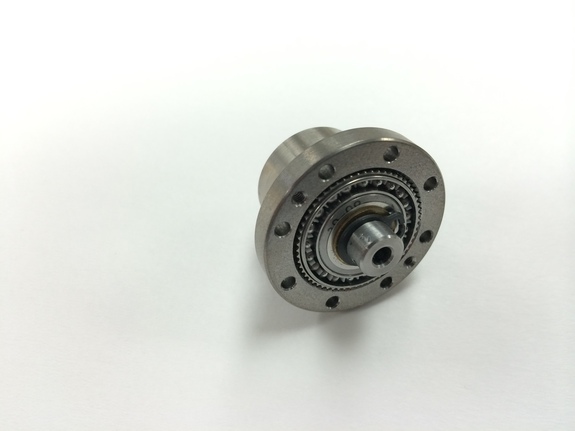
Gears Made of Metallic Glass Could Be Ideal for Space Missions


A material known as metallic glass, created by liquefying and then rapidly cooling metal, might be an ideal material for making gears for spacefaring robots, according to new research. 

The two new research papers focused on the use of bulk metallic glass (BMG) as a material for crafting gears for space-based missions. Metallic glass is called BMG when it is used to manufacture products larger than 0.04 inches (1 millimeter).

To make BMG, engineers first melt metal. Solid metals have a well-organized, crystalline atomic structure. But when the metal is melted, the atoms lose that structure and become randomly arranged, according to a statement from NASA. If the metal cools slowly, the atoms will go back to the crystalline arrangement. But if the liquid metal is cooled extremely rapidly — about 1,800 degrees Fahrenheit (1,000 degrees Celsius) per second — then the disorganized atomic structure remains. [Video: NASA Tests Robotic Refueling Tech]

These rapidly cooled metals are also known as amorphous metals, and "by virtue of being cooled so rapidly, the material is technically a glass. It can flow easily and be blow-molded when heated, just like windowpane glass," NASA scientists explained in the statement. 

Metallic glass was first developed at the California Institute of Technology in the 1960s, and "has been used to manufacture everything from cell phones to golf clubs," NASA said in the statement. 

To find out if BMG might be a good material for making gears for spacecraft, Douglas Hofmann, a technologist at NASA's Jet Propulsion Laboratory and the lead author on the two new research papers, made gears from BMG and tested them at very low temperatures. One of the new papers, published in the journal Advanced Engineering Materials, shows that the gears demonstrate "strong torque" and smooth operation without lubricant at temperatures reaching minus 328 degrees Fahrenheit (minus 200 degrees Celsius).
An example of a strain wave gear, also known as a harmonic drive — one of the most expensive types of gears used in high-precision robotics. As the gear turns, the flexible ring inside it squeezes, becoming an oval shape.
Credit: NASA/JPL-Caltech

The gears' ability to function at very low temperatures is important for two reasons. First, some materials (including some metals) become brittle at cold temperatures, but that isn't the case with metallic glass.. That means there's less risk that a gear tooth will break during operations, according to the statement. 

The second benefit has to do with power consumption. "Being able to operate gears at the low temperature of icy moons, like [Jupiter's] Europa, is a potential game changer for scientists," said R. Peter Dillon, a technologist and program manager in JPL's Materials Development and Manufacturing Technology Group. "Power no longer needs to be siphoned away from the science instruments for heating gearbox lubricant, which preserves precious battery power."

Other benefits of BMG gears may result from low cost and ease of manufacturing. Parts made from BMG can be cast using injection-molding technology, according to the NASA statement, which means the material is liquefied and injected into a mold. This technique is also used to manufacture plastic parts. 

The second paper by Hofmann and colleagues demonstrates that BMG gears might be more cost-effective than so-called strain wave gears, which are "ubiquitous in expensive robots," according to the statement. In particular, these gears include a flexible metal ring that is "tricky to mass-produce and ubiquitous in expensive robots," NASA officials said in the statement. BMG gears can be manufactured for less, according to the paper.

"Mass-producing strain wave gears using BMGs may have a major impact on the consumer robotics market," Hofmann said. "This is especially true for humanoid robots, where gears in the joints can be very expensive but are required to prevent shaking arms. The performance at low temperatures for JPL spacecraft and rovers seems to be a happy added benefit."