INTERNATIONAL SPACE

Wednesday, 19 October 2016

NASA's Juno Probe Sidelined Just Before Jupiter Flyby


NASA's Juno spacecraft has encountered its second problem at Jupiter in less than a week.

The probe went into a protective "safe mode" at 1:47 a.m. EDT (0547 GMT) this morning (Oct. 19), preventing the spacecraft from gathering any data during today's highly anticipated second close flyby of the solar system's largest planet, NASA officials said.

"At the time safe mode was entered, the spacecraft was more than 13 hours from its closest approach to Jupiter," Juno project manager Rick Nybakken, of NASA's Jet Propulsion Laboratory in Pasadena, California, said in a statement today.

"We were still quite a ways from the planet's more intense radiation belts and magnetic fields," Nybakken added in the same statement. "The spacecraft is healthy, and we are working our standard recovery procedure."

Juno went into safe mode when a "software-performance monitor" caused the probe's onboard computer to reboot, NASA officials said. The issue is not related to an apparent problem with a set of valves in Juno's propulsion system, the officials added.

The valve issue, which was publicly disclosed Friday (Oct. 14), caused Juno's handlers to postpone the spacecraft's final engine burn. The maneuver was originally scheduled to take place during today's close Jupiter flyby; it would have shifted Juno from the spacecraft's current, highly elliptical, 53-day orbit to a 14-day path — the probe's final science orbit.

The earliest this burn can now be performed is Dec. 11, during Juno's next Jupiter close encounter, NASA officials have said.


The $1.1 billion Juno mission launched in August 2011 and arrived at the gas giant this past July 4. Juno's main science goal involves mapping out Jupiter's internal structure, composition, gravity and magnetic fields in detail. This information should reveal key insights about how Jupiter, and the rest of the solar system, formed and evolved, mission team members have said.


The original plan calls for Juno to circle Jupiter more than 30 times in the final 14-day orbit before the mission wraps up in February 2018. The spacecraft gathers most of its useful data during each orbit's close flyby; at most other times, Juno is quite far from Jupiter.

Juno's first close flyby (after the July 4 orbital insertion) occurred on Aug. 27.


Posted by AVADHAR at 21:56 No comments:
Email ThisBlogThis!Share to XShare to FacebookShare to Pinterest

‘ദൈവം വസിക്കുന്ന’ ബഹിരാകാശരാഷ്ട്രം നിർമിക്കാൻ റഷ്യൻ ശാസ്ത്രജ്ഞൻ


asgardia-space-station-credit-to-James-Vaughan


സിറിയയിൽ എസ്-300വിഎം മിസൈൽ സിസ്റ്റം സ്ഥാപിച്ചതിന്റെ പേരിൽ അമേരിക്കയുമായി അടിയുടെ വക്കിലാണ് റഷ്യ. തങ്ങളുടെ സൈനികർക്ക് ഐഎസ് ഭീകരരിൽ നിന്ന് രക്ഷനൽകാനാണ് ഈ മിസൈൽ വിന്യാസമെന്ന റഷ്യയുടെ വാദം പക്ഷേ യുഎസ് അംഗീകരിച്ച മട്ടില്ല. സംഗതി മൂന്നാംലോകമഹായുദ്ധത്തിലേക്കു കടക്കുകയാണെന്ന വിധത്തിൽ റിപ്പോർട്ടുകൾ വരെ വന്നുകൊണ്ടിരിക്കുന്നു. #WW3 എന്ന ഹാഷ്ടാഗുമായി ‘ന്യൂക്ലിയർ വാർ’ വരെ ഉൾപ്പെടുത്തിയാണ് ട്വിറ്ററിലെ ചർച്ച. ഇങ്ങനെ റഷ്യയെന്ന പേര് ലോകം യുദ്ധവുമായി കൂട്ടിച്ചേർത്ത് വായിക്കുന്ന സമയത്താണ് അവിടെ നിന്നൊരു സമാധാന വാർത്ത, അതും ലോകനന്മയ്ക്കു വേണ്ടി. 

യുദ്ധത്തിൽ നിന്നു മാത്രമല്ല ഉൽക്കകളുടെ ആക്രമണത്തിൽ നിന്നു വരെ ഭൂമിയെ രക്ഷിക്കാനുള്ള ‘ബഹിരാകാശരാഷ്ട്ര’മാണ് റഷ്യൻ ശാസ്ത്രജ്ഞനായ ഡോ.ഇഗോർ ആഷെർ ബെയ്‌ലിയുടെ നേതൃത്വത്തിലൊരുങ്ങുന്നത്. വിയന്ന ആസ്ഥാനമായി ഇദ്ദേഹം സ്ഥാപിച്ച ഏറോസ്പേസ് ഇന്റർനാഷനൽ റിസർച്ച് സെന്റർ എന്ന സ്വകാര്യ കമ്പനിക്കാണ് ഇതിന്റെ നിർമാണചുമതല. ‘അസ്ഗാർഡിയ’ എന്നു പേരിട്ടിരിക്കുന്ന ഈ രാഷ്ട്രത്തിലെ ‘പ്രജ’യാകാൻ ലോകത്തിന്റെ ഏതുഭാഗത്തു നിന്നുള്ളവർക്കും അപേക്ഷിക്കാം. (‘ദൈവം താമസിക്കുന്ന ഗ്രഹം’ എന്നാണ് നോർവീജിയൻ മിത്തോളജി പ്രകാരം ‘അസ്ഗാർ’ എന്ന വാക്കിന്റെ അർഥം) 

അംഗത്വ റജിസ്ട്രേഷനായി https://asgardia.space എന്ന വെബ്സൈറ്റും ഒരുക്കിയിട്ടുണ്ട്. ഇതിനോടകം അഞ്ചു ലക്ഷത്തിലേറെപ്പേർ റജിസ്റ്ററും ചെയ്തു. ‘കേൾക്കുമ്പോൾ ഒരു വട്ടൻ റഷ്യൻ റോക്കറ്റ് ശാസ്ത്രജ്ഞന്റെ വാക്കുകളായി നിങ്ങൾക്കു തോന്നാം...’ എന്നാണ് അസ്ഗാർഡിയയെപ്പറ്റിയുള്ള വാർത്താസമ്മേളനത്തിൽ ഡോ.ഇഗോർ പറഞ്ഞതു തന്നെ. പക്ഷേ യൂറോപ്യൻ സ്പേസ് ഏജൻസിയിൽ വർഷങ്ങളുടെ പ്രവൃ‍ത്തിപരിചയമുള്ള ഗവേഷകർ ഉൾപ്പെടെയാണ് അസ്ഗാർഡിയക്കു വേണ്ടി പ്രവർത്തിക്കുന്നത്. യുനെസ്കോയുടെ സയൻസ് ഓഫ് സ്പേസ് കമ്മിറ്റി ചെയർമാനുമാണ് ഡോ.ഇർഗോ. കോർ സാറ്റലൈറ്റുകളുടെ ഒരു കൂട്ടം, ചെറുസാറ്റലൈറ്റുകളുടെ കൂട്ടം, സുരക്ഷിതമായ ഒരു സ്പേസ് പ്ലാറ്റ്ഫോം ഇതെല്ലാം ചേർന്നതായിരിക്കും അസ്ഗാർഡിയ. സംഗതി തമാശയാണെന്നു കരുതരുത്, ഈ ബഹിരാകാശ രാഷ്ട്രത്തിലേക്കുള്ള ആദ്യത്തെ സാറ്റലൈറ്റ് അടുത്തവർഷം അവസാനത്തോടെ പറന്നുയരും. 


Asgardia-744x434


പക്ഷേ, അത്ര എളുപ്പമല്ല കാര്യങ്ങൾ


‘ഭൂമിയിലും ആകാശത്തും സമാധാനം’ ഇതാണ് അസ്ഗാർഡിയയുടെ പരമമായ ലക്ഷ്യം. ഒരു ‘സ്വതന്ത്രരാഷ്ട്ര’ത്തിന്റെ സ്വഭാവമായിരിക്കും ഇതിനും. ഭൂമിയിലെ ജനങ്ങളെ സംരക്ഷിക്കുക ഒപ്പം ബഹിരാകാശത്ത് സമാധാനം നിലനിർത്തുക-ഈ മുദ്രാവാക്യവുമായിട്ടായിരിക്കും അസ്ഗാർഡിയ ഭൂമിയെ വലംവയ്ക്കുക. പക്ഷേ ഈ ലക്ഷ്യം തന്നെയാണ് ഇത്തരമൊരു രാഷ്ട്രമെന്ന നീക്കത്തിന് തിരിച്ചടിയാകുന്നതും. നിലവിലെ രാജ്യാന്തര ബഹിരാകാശ ഉടമ്പടി പ്രകാരം സ്പേസിൽ ആർക്കും, ഒരുരാജ്യത്തിനും അങ്ങനെ പ്രത്യേകിച്ചുള്ള അധികാരങ്ങളൊന്നുമില്ല. അങ്ങനെയിരിക്കെ ‘റജിസ്റ്റർ’ ചെയ്ത വ്യക്തികളുമായി മാത്രം ഒരു ബഹിരാകാശ രാഷ്ട്രത്തിന്റെ കാര്യം ആലോചിക്കുക പോലും വേണ്ട. പക്ഷേ ഡോ.ഇഗോർ പ്രതീക്ഷയിലാണ്. 

അംഗത്വറജിസ്ട്രേഷൻ പൂർത്തിയായ ശേഷം ആ വിവരങ്ങൾ ഉൾപ്പെടെ നൽകി ഐക്യരാഷ്ട്രസഭയ്ക്കു കീഴെ ‘സ്വതന്ത്രരാഷ്ട്ര’മായി അംഗീകരിക്കാനുള്ള അപേക്ഷ നൽകുമെന്നാണ് അദ്ദേഹം പറയുന്നത്. അസ്ഗാർഡിയക്ക് സ്വന്തമായി ഭരണഘടനയും ഗവണ്മെന്റും വിവിധ രാജ്യങ്ങളുടെ എംബസിയും ദേശീയഗാനവും പതാകയും ദേശീയ ചിഹ്നവുമൊക്കെയുണ്ടാകും. ഭൂമിയിലിരുന്നായിരിക്കും നിയന്ത്രണമെന്നു മാത്രം. ഇവിടേക്കു വരാൻ പാസ്പോർട്ടും വേണം. ലോകത്തെ ആദ്യ ബഹിരാകാശ രാഷ്ട്രത്തിനു വേണ്ടിയുള്ള പതാകയും ദേശീയഗാനവും ചിഹ്നവും തയാറാക്കാനുള്ള മത്സരം പൊതുജനങ്ങൾക്കായി വെബ്സൈറ്റിൽ ആരംഭിച്ചു കഴിഞ്ഞു. 


ഉൽക്കകളെ തടയും, സൗരവാതത്തെയും


ഭൂമിക്കു നേരെ മുഴുവൻ സമയവും നിരീക്ഷണമുണ്ടാകും അസ്ഗാർഡിയയിൽ നിന്ന്. ഒപ്പം ബഹിരാകാശത്തേക്കുമുണ്ടാകും കണ്ണുകൾ. ഉൽക്കകൾ, ഛിന്നഗ്രഹങ്ങൾ, സൗരവാതം തുടങ്ങിയ ഭീഷണിയെപ്പറ്റി നേരത്തേത്തന്നെ മനസിലാക്കി അവ ഭൂമിയിലേക്കു പതിക്കാതെ ബഹിരാകാശത്തു വച്ചു തന്നെ ‘തീർക്കാനുള്ള’ പദ്ധതിയുമുണ്ട് ഡോ. ഇഗോറിന്റെ മനസിൽ. ബഹിരാകാശത്ത് ആയുധം സംഭരിച്ചും സാറ്റലൈറ്റുകളെ തകർത്തും വിവിധ രാഷ്ട്രങ്ങൾ ലക്ഷ്യമിടുന്ന ‘സ്പേസ് വാർ’ ഒഴിവാക്കാനുള്ള ശ്രമവും അസ്ഗാർഡിയ നടത്തും. കൂടാതെ ഭൂമിയിലെ അവികസിത രാജ്യങ്ങൾക്കു പോലും സ്പേസ് ടെക്നോളജി ലഭ്യമാക്കും വിധം പരീക്ഷണങ്ങൾക്കുള്ള സൗകര്യവുമൊരുക്കും. 


Asgardia_satellite


പക്ഷേ ഭൂമിയിൽ എന്തെങ്കിലും പ്രശ്നമുണ്ടായാൽ ഇവിടേക്ക് രക്ഷപ്പെട്ടുകളയാമെന്നൊന്നും റജിസ്റ്റർ ചെയ്തവർ കരുതേണ്ട. മനുഷ്യന് ഇവിടേക്ക് സ്ഥിരമായി താമസിക്കാനാകും വിധത്തിൽ സാങ്കേതികത വളരാൻ ഇനിയുമേറെ വർഷങ്ങളെടുക്കും. മാത്രവുമല്ല ബഹിരാകാശ ഗവേഷകർക്കും പിന്നെ അസ്ഗാർഡിയക്കു വേണ്ടി പണം മുടക്കിയിട്ടുള്ളവർക്കും മാത്രമാണ് ആദ്യഘട്ടത്തിൽ അംഗത്വം ലഭ്യമാക്കുക. ക്രൗഡ് ഫണ്ടിങ് വഴിയും പണം ശേഖരിക്കാനൊരുങ്ങുകയാണ് ഡോ.ഇഗോറും സംഘവും. 


Posted by AVADHAR at 21:51 No comments:
Email ThisBlogThis!Share to XShare to FacebookShare to Pinterest

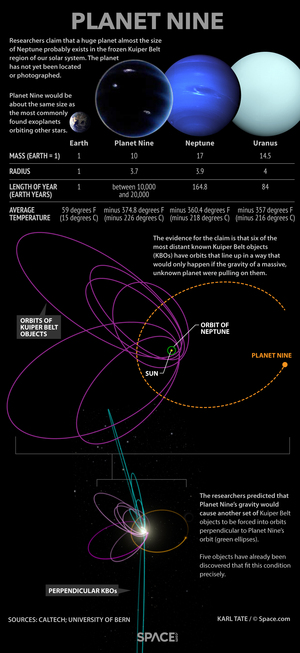
Did the Mysterious 'Planet Nine' Tilt the Solar System?


PASADENA, Calif. — The putative "Planet Nine" may have tilted the entire solar system, researchers say. 

In January, astronomers revealed evidence for the potential existence of another planet in the solar system. Researchers suggest that if this world — dubbed Planet Nine — exists, it could be about 10 times Earth's mass and orbit the sun at a distance about 500 times the distance from the Earth to the sun.

Previous research suggested that Planet Nine would possess a highly tilted orbit compared with the relatively thin, flat zone in which the eight official planets circle the sun. This led scientists to investigate whether Planet Nine's slant might help explain other tilting seen elsewhere in the solar system.

Now, researchers suggest that Planet Nine's influence might have tilted the entire solar system except the sun.

"Planet Nine may have tilted the other planets over the lifetime of the solar system," said study lead author Elizabeth Bailey, an astrophysicist and planetary scientist at the California Institute of Technology in Pasadena.

Prior work found that the zone in which the eight major planets orbit the sun is tilted by about 6 degrees compared to the sun's equator. This discrepancy has long been a mystery in astronomy.


Researchers say an anomaly in the orbits of distant Kuiper Belt objects points to the existence of an unknown planet orbiting the sun. <a href="http://www.space.com/31671-planet-nine-discovery-explained-infographic.html">Here's what we know of this potential "Planet Nine."</a>

Bailey and her colleagues ran computer simulations that suggest that the tilt of the eight official planets can be explained by the gravitational influence of Planet Nine "over the 4.5-billion-years-ish lifetime of the solar system," Bailey told Space.com.

Bailey did note that there are other potential explanations for the tilt of the solar system. One alternative is that electrically charged particles influenced by the young sun's magnetic field could have interacted with the disk of gas and dust that gave rise to the planets in ways that tilted the solar system. Another possibility is that there might have been an imbalance in the mass of the nascent sun's core.

"However, all these other ways to explain why the solar system is tilted are really hard to test — they all invoke processes that were possibly present really early in the solar system," Bailey said. "Planet Nine is the first thing that has been proposed to tilt the solar system that doesn't depend on early conditions, so if we find Planet Nine, we will be able to see if it's the only thing responsible for the tilt, or if anything else may have played a role."

The scientists detailed their findings yesterday (Oct. 18) at a joint meeting of the American Astronomical Society's Division for Planetary Sciences and European Planetary Science Congress in Pasadena, California.


Posted by AVADHAR at 21:44 No comments:
Email ThisBlogThis!Share to XShare to FacebookShare to Pinterest

WATCH LIVE @ 9 a.m. EDT: ExoMars Landing Webcast from European Space Agency

WATCH LIVE @ 9 a.m. EDT: ExoMars Landing Webcast from European Space Agency

The European Space Agency will have live coverage of the ExoMars lander's touchdown on Mars in a series of webcasts. First, a Social TV program will cover the arrival and landing beginning and 9 a.m. EDT (1300 GMT) and should also be simulcast in the window below. Then ESA's main program will follow in two parts, one from 11:44 a.m. – 12:59 p.m. EDT (1544–1659 GMT)and the other from 2:25 – 4:03 p.m. EDT (1825–2003 GMT). The webcasts are among a series of broadcasts by ESA to chronicle the ExoMars arrival. You can watch the webcast directly from ESA here and in the window below.Preview Story: High Stakes: Europe Aims for 1st Successful Mars Landing Today

In addition to text updates here and via our twitter channels, a short statement confirming the outcome of the separation will be streamed live from the main control room of ESA's Spacecraft Operations Centre starting at 14:30 GMT / 16:30 CEST.

19 October – landing and arriving at Mars


Live coverage of ExoMars Trace Gas Orbiter arrival and Schiaparelli landing on Mars will begin with our Social TV programme via ESA’s Facebook page and Livestream 13:00–15:15 GMT / 15:00–17:15 CEST on 19 October.


The ESA TV programme will be broadcast on this page in two parts on 19 October:

15:44–16:59 GMT / 17:44–18:59 CEST
18:25–20:03 GMT / 20:25–22:03 CEST

20 October – status report and first images

A press conference is scheduled for 20 October at 08:00 GMT / 10:00 CEST, when a mission status update is expected, along with the first images from the Schiaparelli descent camera. This will also be streamed live via the player above.

For additional mission status text updates starting 14 October, see here.

Times subject to change.


Mission Description from ESA


The ExoMars 2016 mission will enter orbit around the Red Planet on 19 October. At the same time, its Schiaparelli lander will descend to the surface. Representatives of traditional and social media are invited to attend a two-day event at ESA’s ESOC control centre in Darmstadt, Germany.

ExoMars is a joint endeavour between ESA and Russia’s Roscosmos space agency, and comprises the Trace Gas Orbiter (TGO) and the Schiaparelli entry, descent and landing demonstrator.

TGO will make a detailed inventory of Mars’ atmospheric gases, with particular interest in rare gases like methane, which implies that there is an active, current source. TGO aims to measure methane’s geographical and seasonal dependence and help to determine whether it stems from a geological or biological source.

TGO will start its science mission at the end of 2017, following a year of complex aerobraking manoeuvres to circularise its orbit. It will also act as a relay for ESA’s ExoMars 2020 rover.

Schiaparelli will separate from TGO on 16 October, entering the atmosphere for a six-minute descent to a region in Meridiani Planum, on 19 October.

It will test a range of technologies to enable a controlled descent and landing on Mars in preparation for future missions, including a heatshield, a parachute, a propulsion system and a crushable structure.

Schiaparelli also carries a small science package that will record the wind speed, humidity, pressure and temperature at its landing site,as well as obtain the first measurements of electric fields on the surface of Mars that may provide insight into how dust storms are triggered.

The separation of Schiaparelli from TGO will be covered online. Media are invited to join mission experts at ESOC on 19 October to follow the orbit insertion of TGO and the landing of Schiaparelli, and to attend a briefing on 20 October when the first descent camera images are expected.
On Friday: Space Station Crew Arrives

A Russian Soyuz MS-02 spacecraft will arrive at the International Space Station on Friday (Oct. 21) at 5:59 a.m. EDT (0959 GMT) to ferry a NASA astronaut and two Russian cosmonauts to the orbiting laboratory. You can watch the arrival live here, beginning at 5:15 a.m. EDT (0915 GMT). 

"NASA astronaut Shane Kimbrough, along with Roscosmos cosmonauts Sergey Ryzhikov and Andrey Borisenko, will travel for two days in the Soyuz MS-02 spacecraft to test upgraded spacecraft systems before docking to the space station’s Poisk module at 5:59 a.m. Friday, Oct. 21. NASA TV coverage of the docking will begin at 5:15 a.m.

"Hatches between the Soyuz and station will open at approximately 8:35 a.m., and the arriving crew will be welcomed on board by Expedition 49 Commander Anatoly Ivanishin of Roscosmos and Flight Engineers Kate Rubins of NASA and Takuya Onishi of the Japan Aerospace Exploration Agency, who have been aboard the complex since July. NASA TV coverage of hatch opening and welcoming ceremonies will begin at 8 a.m.

"The original launch date of Sept. 23 was postponed due to a technical issue with the Soyuz spacecraft, which Roscosmos repaired.

"Kimbrough, Ryzhikov and Borisenko will spend a little more than four months together aboard the orbital complex before returning to Earth in late February. The full six-person crew will continue work on hundreds of experiments in biology, biotechnology, physical science and Earth science aboard the International Space Station, humanity’s only microgravity laboratory."


Posted by AVADHAR at 03:31 No comments:
Email ThisBlogThis!Share to XShare to FacebookShare to Pinterest

Volcanoes on Venus Erupted Recently, New Study Suggests


PASADENA, Calif. –Volcanic activity on Venus took place in the recent past, geologically speaking, and may still be happening on the planet today. New research takes a deeper look at one recent eruption on Venus' surface.

The Idunn Mons volcano in the southwestern hemisphere of Venus rises 1.6 miles (2.5 kilometers) above the surrounding plains. In 2010, observations by the European Space Agency's Venus Express probe revealed that Idunn Mons is a "hotspot," meaning it radiates high levels of infrared light compared to the surrounding area. That suggests that lava flowed at the spot recently, and that the area is still warm.

Now, a more nuanced look at Idunn Mons suggests that the hotspot observations are consistent with multiple (cooled) lava flows along the volcano's eastern flank, the new research shows. The researchers behind the new work said the finding suggests that Venus' volcanos were active in the relatively recent past, and may still be active today. 

"Venus is a planet which has always been considered Earth's twin sister," said Piero D'Incecco of the German Aerospace Center and one of the researchers behind the new analysis. "But its cloud cover still hides a lot of secrets."

D'Incecco spoke at a media briefing at the American Astronomical Society Division for Planetary Sciences meeting in Pasadena, California.

Venus Express initially identified the hotspot on Idunn Mons in 2010 using the Visible and Infrared Thermal Imaging Spectrometer (VIRTIS) instrument. Most of Venus' surface appears cool when viewed with VIRTIS, and this is a sign that those regions haven't changed (geologically speaking) in millions of years. By contrast, the researchers who initially studied the hotspot estimated that the region could be less than 2.5 million years old. Unfortunately, the thick clouds that cover Venus prevented the Venus Express probe from getting a more detailed look at the volcano and the lava flows.


The new analysis of lava flows on Idunn Mons uses radar data collected in the early 1990s by NASA's Magellan probe. D'Incecco and colleagues built a new numerical model to simulate lava flows on the top of the mountain and the eastern flanks, and compared that model with the Magellan data.

The new analysis of lava flows on Idunn Mons uses radar data collected in the early 1990s by NASA's Magellan probe. D'Incecco and colleagues built a new numerical model to simulate lava flows on the top of the mountain and the eastern flanks, and compared that model with the Magellan data.

"According to our modeling, the flank lava flows are the ones responsible for this [hot]spot," D'Incecco said. "This is particularly important because this is the first time we can map, with such a high resolution, lava flows from a volcanic structure which is believed to be recently or still active on a terrestrial body other than Earth."

Posted by AVADHAR at 03:23 No comments:
Email ThisBlogThis!Share to XShare to FacebookShare to Pinterest

Chinese Astronauts Dock with Tiangong-2 Space Lab


A Chinese spacecraft carrying two astronauts has successfully docked with the uncrewed Tiangong-2 space lab, according to Chinese media reports.

The Shenzhou-11 spacecraft linked up with Tiangong-2 at 3:24 p.m. EDT (1924 GMT) today (Oct. 18; 3:24 a.m. Oct. 19 Beijing time), while both spacecraft were zipping around Earth at an altitude of 244 miles (393 kilometers), China's state-run Xinhua news agency reported.

Though Shenzhou-11 carries two crewmembers, named Jing Haipeng and Chen Dong, the docking was completely automated.

Jing and Chen will soon enter Tiangong-2, then stay aboard the orbiting lab for 30 days. The duo are undertaking China's longest-ever crewed space mission; they lifted off on Sunday (Oct. 16) and will be in orbit for a total of 33 days if all goes according to plan, Xinhua reported.


The 34-foot-long (10.4 meters) Tiangong-2 launched to orbit on Sept. 15. The 9.5-ton module is China's second-ever space lab; the first, Tiangong-1, reached space in September 2011 and hosted three dockings — two of them involving crewed Shenzhou spacecraft — before ending its operational life this past March.

Tiangong-1 will likely fall to Earth in late 2017, Chinese space officials have said.

The Tiangong program is designed to test out the rendezvous and docking technologies that China will need to build a bona fide space station, which the nation aims to have up and running by the early 2020s.

China's space station will likely be considerably smaller than the 440-ton, $100 billion International Space Station; various reports have estimated that China's orbiting complex will tip the scales at about 60 tons.


Shenzhou-11 is China's first crewed spaceflight in more than three years. The most recent such effort, Shenzhou-10, sent three astronauts to Tiangong-1 in June 2013. The Shenzhou-10 crewmembers spent 14 days in space — the Chinese spaceflight record that Jing and Chen are poised to break.


Posted by AVADHAR at 03:11 No comments:
Email ThisBlogThis!Share to XShare to FacebookShare to Pinterest

Watch a Space Crew Launch & a European Probe Land on Mars Wednesday


A new, space-station-bound crew will lift off early Wednesday morning (Oct. 19), and Europe's Schiaparelli landing capsule will touch down on the surface of Mars later that day — and you can watch both events live online, courtesy of NASA and the European Space Agency.

First, at 4:05 a.m. EDT (0805 GMT), NASA astronaut Shane Kimbrough and Russian cosmonauts Sergey Ryzhikov and Andrey Borisenko will launch on a two-day journey to the International Space Station from the Baikonur Cosmodrome in Kazakhstan. Coverage will start at 3:15 a.m. EDT (0715 GMT).

Then, starting at 9 a.m. EDT (1300 GMT), the European Space Agency will broadcast coverage of its ExoMars mission's emissary to the surface of the Red Planet, which will touch down over the course of about 6 minutes starting at 10:42 a.m. EDT (1442 GMT). The lander, and the Trace Gas Orbiter, which will remain in Mars orbit, launched from the same Kazakhstan location in March.


The ExoMars orbiter and lander split apart three days ago, after a seven-month trip to the planet. The lander will test out technologies that are intended for use in an ExoMars rover that will launch in 2020 — using heat shields, a 39-foot (12 meters) parachute and its thrusters to slow its descent before dropping to the ground. Over its first few days on the planet, before its battery winds down, the lander will measure Mars' wind speed and direction, humidity, pressure and electric fields, plus the atmosphere's transparency and temperature, and send those measurements up to the orbiter.

As for the space station trip, the three new crewmembers will travel in their Russian Soyuz spacecraft for two days, testing upgraded systems on the craft, before docking to the station at 5:59 a.m. EDT Friday (0959 GMT). The hatches will open and the current space station residents will greet the new arrivals at 8 a.m. EDT (1200 GMT). (Those events will also be live-streamed on Space.com, courtesy of NASA TV.)

It is Kimbrough's second spaceflight; he launched on the space shuttle in 2008 to help assemble the space station — the crew added a bathroom, kitchen, two bedrooms, an exercise machine and water-recycling machine to the station, according to a NASA document. Borisenko is on his second trip to the space station, and this mission is Ryzhikov's first flight into space. All three of them will return home in February.

The new crew arrival will bring the space station's numbers back up to six; NASA astronaut Kate Rubins, Japanese astronaut Takuya Onishi and Russian cosmonaut Anatoly Ivanishin have been alone on the station since Sept. 6.


Posted by AVADHAR at 03:07 No comments:
Email ThisBlogThis!Share to XShare to FacebookShare to Pinterest
Newer Posts Older Posts Home
Subscribe to: Posts (Atom)

About Me

AVADHAR
View my complete profile

Blog Archive

  • ▼  2017 (7)
    • ▼  January (7)
      • Egyptian scientists look to space to shed light ...
      • Speech on Space Research in India Here is y...
      • Search For Intelligent Aliens Near Bizarre Dimmi...
      • A BRIEF HISTORY OF SPACE EXPLORATION Huma...
      • SATURN FACTS Saturn is the sixth planet from th...
      • NASA And Virgin Galactic Select Payloads For Fir...
      • Team Indus, ISRO aim for January 26, 2018 to pla...
  • ►  2016 (112)
    • ►  December (21)
    • ►  November (4)
    • ►  October (54)
    • ►  September (33)
Watermark theme. Powered by Blogger.