Thursday, 6 October 2016


Blue Origin Pitches Space Tourists Package Deal to Ride Orbital Rocket


Blue Origin hopes people use the company to get two different sets of astronaut wings.

Blue Origin, which is run by billionaire Amazon.com founder Jeff Bezos, is developing a reusable rocket-and-capsule combo called New Shepard to take people (and experiments) on brief trips to suborbital space. And last month Bezos unveiled New Glenn, a huge orbital vehicle that the company aims to start flying by 2019 or so.

If you want to be one of the first to ride New Glenn to Earth orbit, you should pony up for a seat aboard New Shepard, Blue Origin representatives said. 

"We're going to make sure that our astronauts that fly on New Shepard are going to get first access to tickets on New Glenn," Ariane Cornell, who's on Blue Origin's Strategy and Business Development team, said Wednesday (Oct. 5) during the live webcast of New Shepard's in-flight escape test.

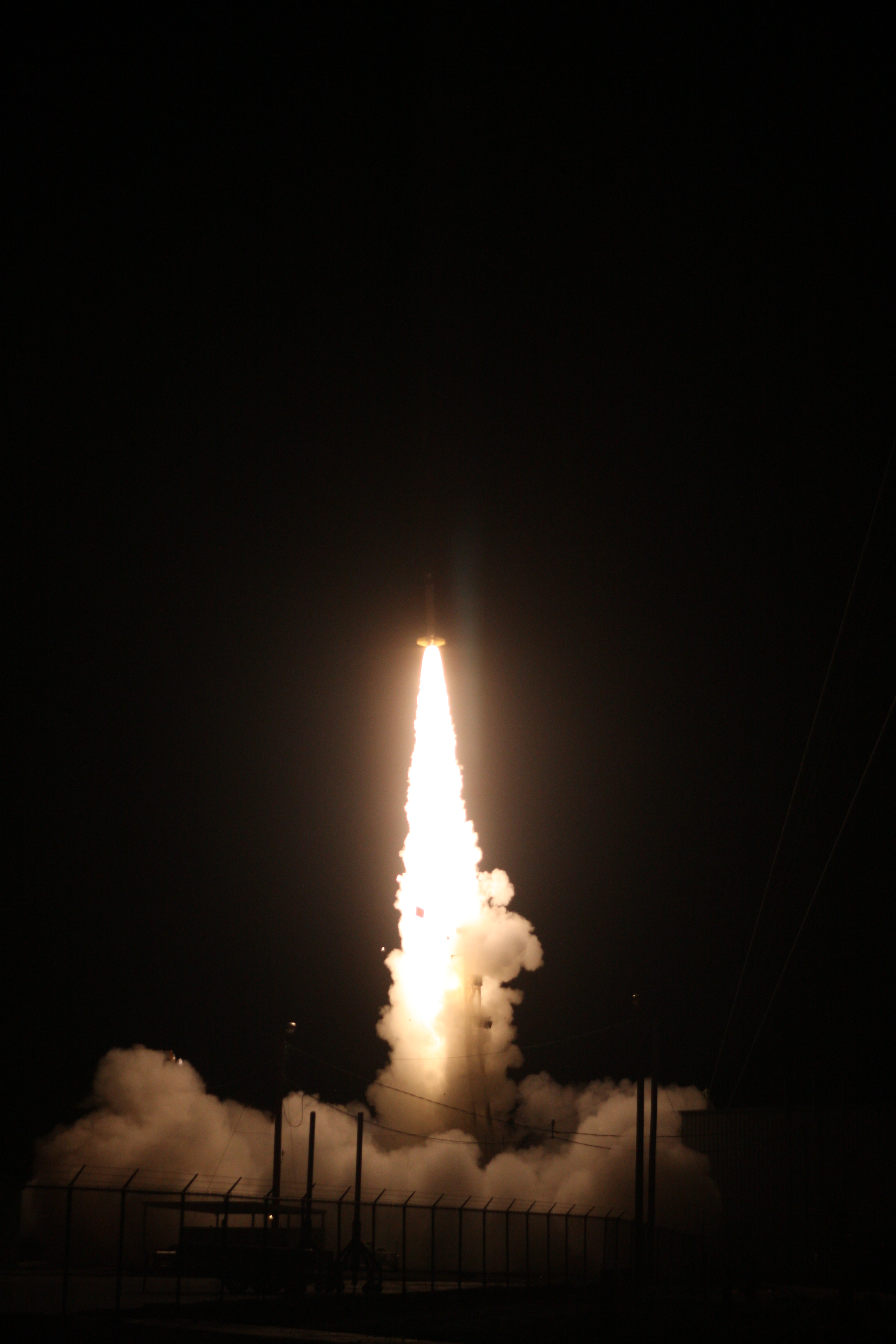
That uncrewed test showed how the New Shepard capsule would keep astronauts safe during a real-life launch emergency. About 45 seconds after lifting off from Blue Origin's west Texas test site on Wednesday morning, the capsule briefly fired its onboard escape motor, blasting itself well clear of the booster.

The capsule made a parachute-aided landing shortly thereafter, and the rocket aced its own touchdown on the launch pad a few minutes later. (That same rocket has now launched and landed on five separate suborbital spaceflights, but it apparently will now be retired; Bezos said last month that Blue Origin will put the rocket on display in a museum if it survives today's test.)

Blue Origin may begin crewed test flights of the New Shepard system next year, with commercial operations possibly beginning as early as 2018, Bezos has said.

New Shepard will take passengers 62 miles (100 kilometers) above Earth's surface — the traditionally recognized boundary line where outer space begins. Customers will experience about 4 minutes of weightlessness during the 11-minute flight and see the curvature of the Earth against the blackness of space, Cornell said during today's webcast.


Blue Origin has not yet revealed how much a New Shepard ticket will cost. The company's chief suborbital-spaceflight competitors, Virgin Galactic and XCOR Aerospace, are currently charging $250,000 and $150,000 per seat, respectively, if that's any guide.

A ticket to orbit aboard New Glenn will be quite a bit pricier than any suborbital jaunt, so it's safe to say that anyone who rides both New Shepard and New Glenn in the near future will be a very well-to-do individual. But that may not always be true; Bezos aims to slash the cost of spaceflight via the development of reusable rockets and spaceships, and his stated vision for Blue Origin is to help create a future in which millions of people are living and working in space.




CubeSats: Tiny Payloads, Huge Benefits for Space Research


CubeSats: Tiny Payloads, Huge Benefits for Space Research


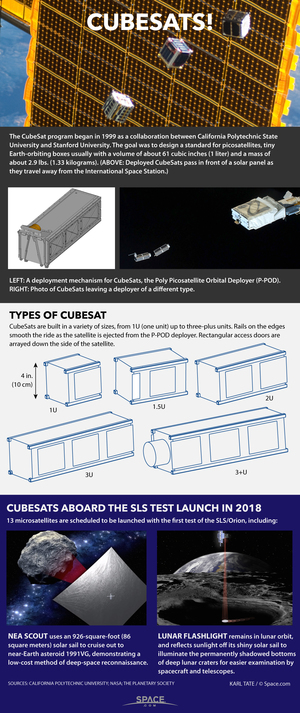
CubeSats are miniature satellites that are commonly used in low Earth orbit for applications such as remote sensing or communications. As engineers become more familiar with the technology, CubeSats are also being considered for flights outside of Earth orbit — particularly to locations such as Mars or Jupiter.

The design was first proposed in the late 1990s by two professors: Jordi Puig-Suari of California Polytechnic State University and Bob Twiggs of Stanford University. They were trying to help students gain engineering experience in satellites, which are traditionally expensive to build and launch. Inspiration for the CubeSat came in part from the miniature toy craze of the day, Beanie Babies, according to Spaceflight Now.

The basic design of a CubeSat is a 10-centimeter (4-inch) cube with a mass of less than 1.33 kilograms (2.93 pounds), the article added. But variations on the theme are possible. CubeSats can also be designed to encompass two, three or six 10-centimeter units for more complicated missions.

CubeSats reduce launch costs in two fundamental ways. They don't weigh that much, which means a rocket doesn't need a lot of fuel to heft them. In most cases, they also share a rocket with a larger satellite, making it possible to get to space on the coattails of the heavier payload.

There are some design challenges with CubeSats, however. The electronics are smaller and are therefore more sensitive to radiation. Because they are small, they cannot carry large payloads with them. And because most are deployed to low Earth orbit, they are only designed to last a few months or years before falling back into the atmosphere.

Three small CubeSats float above the Earth after deployment from the International Space Station. Astronaut Rick Mastracchio tweeted the photo from the station on Nov. 19, 2013.

Brief history


The first six CubeSats were launched in June 2003 from Russia's Plesetsk launch site. At the time, according to a Space.com article from 2004, the going rate for a CubeSat's launch was about $40,000, which is a bargain compared to a typical satellite (that can cost hundreds of thousands, or millions.)

CubeSats were made possible by the ongoing miniaturization of electronics, which allows instruments such as cameras to ride into orbit at a fraction of the size of what was required at the beginning of the space age in the 1960s.

"Peep inside a CubeSat and you'll spot off-the-shelf circuitry in the familiar form of microprocessors and modem ports, and other microchip devices typically used in cell phones, digital cameras and hand-held Global Positioning System (GPS) satellite navigation units," wrote Space.com insider columnist Leonard David in 2004.

Tiny cubesats are revolutionizing how scientists, students and even private companies explore and utilize space. <a href="http://www.space.com/29320-cubesats-spacecraft-tech-explained-infographic.html">See how cubesat technology makes satellites smaller in our full infographic</a>.For the first decade, most CubeSats that flew came from university or research applications. Only a handful of satellites launched every year. That all began to change in 2013, when the number of launches suddenly numbered in the dozens. It was in that year that the commercial sector began to launch satellites, according to SpaceDaily.

Some prominent uses of CubeSats today include:


  • The Earth observation company Planet Labs, which had nearly 90 CubeSat-sized Dove satellites in orbit as of July 2015. The CubeSats are used in everything from disaster response to climate monitoring.
  • The NanoRacks CubeSat Deployer on the International Space Station, which launches CubeSats after they have been hauled to orbit aboard a visiting ISS vehicle.
  • NASA's CubeSat Launch initiative, which provides launch slots for CubeSats aboard traditional rocket launches.


Moving outside of Earth orbit


While all CubeSats to date have been in Earth orbit, a handful are expected to leave that environment very soon and venture farther afield. Here are some of the projects being planned.

Mars Cube One (MarCO), which will launch in March 2016 along with NASA's InSight lander. The two CubeSats will ride into space and then separate from the booster to make an independent trip to Mars. One of the spacecraft will send data back to Earth as InSight lands on Mars, while the other will be a backup.

NASA's first Space Launch System test launch in 2018 will pioneer the rocket expected to bring humans out of low Earth orbit for the first time since the 1960s. The initial, uncrewed launch will include 13 microsatellites. These will include Lunar Flashlight, which reflects sunlight to peer into permanently shadowed craters on the moon, and NEA Scout, which will use a solar sail to fly to near-Earth asteroid 1991VG.

NASA is considering a mission to Jupiter's icy moon Europa in the 2020s or 2030s. In 2014, NASA said it was considering including CubeSats on the mission, which would carry out functions including "reconnaissance for future landing sites, gravity fields, magnetic fields, atmospheric and plume science, and radiation measurements." The Europa mission is still being designed and as of fall 2016, it is uncertain if CubeSats will go along for the journey.

The European Space Agency and NASA are considering a joint mission to investigate the asteroid 65803 Didymos and try to move its moon via an impactor. The mission is called Asteroid Impact & Deflection Assessment (AIDA) mission. For the European part, it's possible that two CubeSats will ride along to do supplemental observations. If approved, the mission would launch in the 2020s.


Hurricane Matthew's Florida Approach Seen from Space Station 


Image result for Hurricane Matthew's Florida Approach Seen from Space Station


Dramatic footage captured from the International Space Station (ISS) this afternoon (Oct. 6) shows powerful Hurricane Matthew preparing to slam into the southeastern United States.

At about 4:45 p.m. EDT (1845 GMT) today, cameras aboard the ISS recorded video of Hurricane Matthew rumbling toward the Atlantic coast of Florida, which the storm is expected to hit in earnest for the first time tonight.

As of 5 p.m. EDT (2100 GTM) today, Matthew was a Category 4 hurricane — the second-most powerful type — with maximum sustained wind speeds of around 140 mph (225 km/h), according to the U.S. National Hurricane Center (NHC). (Category 5 hurricanes, the strongest type, have max wind speeds topping 157 mph, or 253 km/h.)

The storm was about 100 miles (160 kilometers) east-southeast of West Palm Beach, Florida, and was moving northwest at about 14 mph (23 km/h), according to the NHC's latest update.

Hurricane Matthew has already left a trail of wreckage in the Caribbean, killing more than 100 people as it churned through Haiti and the Bahamas. And things will probably remain bad when the storm reaches the United States; the NHC update warned of "potentially disastrous impacts for Florida," and President Barack Obama has already declared a state of emergency in the state.

"The combination of a dangerous storm surge and the tide will cause normally dry areas near the coast to be flooded by rising waters moving inland from the shoreline," the NHC update said. "There is a danger of life-threatening inundation during the next 36 hours along the Florida east coast, the Georgia coast and the South Carolina coast, from Deerfield Beach, Florida, to South Santee River, South Carolina."

NASA has already closed Kennedy Space Center, which is located on central Florida's Atlantic coast, east of Orlando.


Wednesday, 5 October 2016

Antares Return to Flight Now Scheduled for Oct. 13


NASA and Orbital ATK have set a new launch date of Oct. 13 for the return to flight of the company's Antares launch vehicle on a mission to the International Space Station, the organizations announced Oct. 4.

The launch of the Antares 230 rocket, carrying a Cygnus cargo spacecraft, is scheduled for 9:13 p.m. Eastern Oct. 13 from the Mid-Atlantic Regional Spaceport at Wallops Island, Virginia. The launch was previously scheduled for a window between Oct. 9 and 13.

Orbital ATK said in a statement that it set the launch date after completing a flight readiness review, but didn't disclose why they were now targeting the end of the original window versus the beginning. One potential factor, regardless of the technical readiness of the launch vehicle and spacecraft, is the weather: forecasts project Hurricane Matthew will travel up the East Coast in the next several days, passing Wallops Island Oct. 8.

The new launch window extends through Oct. 19, NASA Wallops spokesman Keith Koehler said Oct. 4. That window could be extended if needed.

The launch, on a mission designated OA-5, will send a Cygnus spacecraft to the International Space Station loaded with about 2,400 kilograms of cargo. Cygnus will arrive at the station, and be berthed by the station's robotic arm, on Oct. 16 assuming a launch on Oct. 13. It will remain at the ISS until Nov. 18.

The launch is also the first flight of the Antares since an October 2014 launch failure. After the accident, Orbital ATK replaced the AJ26 engines used in the vehicle's first stage, and implicated in the failure, with new RD-181 engines from Russian company NPO Energomash. The new engines also provided improve performance for the Antares, increasing its payload capacity.

NASA Rocket Brings Home Cosmic X-Ray Answers — and a New Mystery


A NASA sounding rocket zoomed above Earth's atmosphere, confirming one interstellar source for X-rays and one more local one — and discovering others whose origin remains a mystery.

NASA's rocket, called the Diffuse X-ray emission (DXL) rocket, discovered that some of the X-rays that bombard Earth's atmosphere likely come from the "Local Hot Bubble," which is believed to be a zone of hot interstellar material surrounding the solar system. While the bubble has been hypothesized since the 1990s, DXL showed that its existence is likely true.

Other X-rays happen as a part of solar wind exchange. The solar wind is a constant flow of charged particles from our sun; because the gas is ionized — it includes charged particles and the electrons separated from them — the solar wind can carry electric and magnetic fields. At times, the solar wind pushes into neutral gas (where electrons and ions are more tightly bound), and "excites" the electrons in this gas. When the electrons stabilize, they release energy in the form of X-rays. [The X-Ray Universe: Chandra X-Ray Space Observatory Pictures]But the study scientists also found higher-energy X-rays that originate from an unknown source.


"At higher energies, these sources [solar wind and the Local Hot Bubble] contribute less than a quarter of the X-ray emission," Youaraj Uprety, lead author on the study and an astrophysicist at University of Miami, where the research was conducted, said in a NASA statement. "So there's an unknown source of X-rays in this energy range."
DXL flew for about 15 minutes, providing a glimpse of X-rays beyond the Earth's atmosphere. Earth's atmosphere normally blocks out these high-energy forms of light.

DXL was sent aloft at a time that is advantageous to measure X-rays coming from the solar wind: When the rocket flew, Earth was passing through something called the helium-focusing cone. Space is full of hydrogen and helium; as the solar system passes through it, the neutral helium creates a tail around the sun because helium is heavier than hydrogen.

Scientists were able to use those conditions to figure out how much X-ray emission comes from the solar wind, because the solar wind's exchange depends on interactions with neutral material such as helium. From there, scientists at first hypothesized that all of the remaining X-ray emission comes from the Local Hot Bubble — a large gas pocket that was supercharged by two or three supernova explosions, one inside the other, Massimiliano Galeazzi, an astrophysicist at the University of Miami and an author on the study, said in the same statement. 

But something happened that they weren't expecting. Some of the X-rays detected by the rocket were too high of an energy to be from the Local Hot Bubble, because its temperature is too low. These X-rays also weren't in the helium-focusing cone, and so they didn't come from the solar wind. The origin of this third set of X-rays is completely unknown.

A study based on the research was published Sept. 23 in the Astrophysical Journal.


NASA Sees Powerful Hurricane Matthew from Space


As Hurricane Matthew swirled over the Caribbean yesterday (Oct. 3), the International Space Station caught a glimpse of the massive storm. The space station flew over the Category 4 hurricane at 4:10 p.m. EDT as the storm made its way north through the Caribbean Sea.

The International Space Station (ISS) spied on the potentially deadly hurricane from a safe orbiting altitude of 250 miles (400 kilometers) using the lab's onboard, Earth-viewing cameras. ISS astronauts then tweeted the video shortly afterward.

Early this morning (Oct. 4), the storm made its first landfall in western Haiti, bringing winds of up to 145 mph (233 km/h) and a torrential downpour that forecasters said will amount to more than 2 feet (0.6 meters) of rainfall. Hurricane Matthew's eye is expected to reach Cuba later today, and some forecasts predicted the eye will reach the east coast of the U.S. by Friday.


The ISS wasn't the only satellite observing the hurricane from space. NOAA satellite GOES-East has also been keeping an eye on the storm. Because this satellite has a geostationary orbit, it provides continuous imagery of the eastern U.S. and the Atlantic Ocean by constantly hovering over the same region.

NASA's Global Precipitation Measurement mission or GPM core observatory satellite offers a less realistic, but much more colorful, view of the storm. The satellite flew over Hurricane Matthew on Sunday (Oct. 2) at 5:46 a.m. EDT and measured the precipitation expected to hit Hispaniola. The satellite estimated a downpour rate of at least 6.4 inches (163 millimeters) per hour and measured cloud tops as tall as 9.9 miles (16 km).


"Heaviest rain was seen well to the east of Hurricane Matthew's center," Hal Pierce, of NASA's Goddard Space Flight Center in Greenbelt, Maryland, said in a statement. "This area of strong, convective storms has been persistent over the past few days. This area of intense rainfall is due to convergence between the trade winds (prevailing easterlies) and the wind flow from the south with Matthew. This area of heavy rainfall with Matthew may cause devastating torrential rainfall as it moves slowly over Haiti."

Hurricane Matthew, an exceptionally powerful storm, will continue to slowly creep toward Cuba and the Bahamas before likely hitting Florida by the end of the week.